Early evidence preservation
We identify camera sources, request preservation when appropriate, and gather photos, scene measurements, and witness contact details before they disappear.
If you were hit while riding, you are dealing with more than a crash report. We help you document injuries, prove fault, and pursue the full value of your claim under Georgia law.

A bicycle collision can leave you with medical bills, missed work, and a fast-moving insurance claim. A bicycle accident lawyer Atlanta GA riders trust focuses on two things early: protecting the evidence and protecting your timeline.
In Atlanta, claims often turn on details that disappear quickly. Traffic camera footage can be overwritten, skid marks fade, vehicles get repaired, and witnesses become hard to reach. We step in to gather what matters, coordinate with your medical documentation, and build a clear liability story before the insurer sets the narrative.
We also keep your claim aligned with Georgia deadlines. Under O.C.G.A. § 9-3-33, most personal injury lawsuits must be filed within two years of the date of injury. Waiting can shrink your options, even when liability looks obvious.
You will work with a team that handles bicycle injury cases as personal injury claims, not as “property damage with a bump.” If you also need help with another type of injury case, our broader practice is covered through our personal injury law firm in Atlanta.
Insurance companies often try to reduce a cyclist's claim by framing the crash as “unavoidable” or blaming road conditions. A bicycle accident attorney in Atlanta should be ready to investigate the most common patterns and the proof that goes with them:
Local claims also depend on where the crash happened. Intersections and high-traffic corridors in and around Downtown Atlanta can have multiple camera sources and heavy witness potential, while crashes on quieter neighborhood routes can require faster outreach to nearby businesses and residents for video and statements.
When we can, we obtain the crash report and evaluate whether follow-up is needed. In Atlanta, police services are handled by the Atlanta Police Department, and serious collisions may involve additional investigative resources depending on the circumstances.
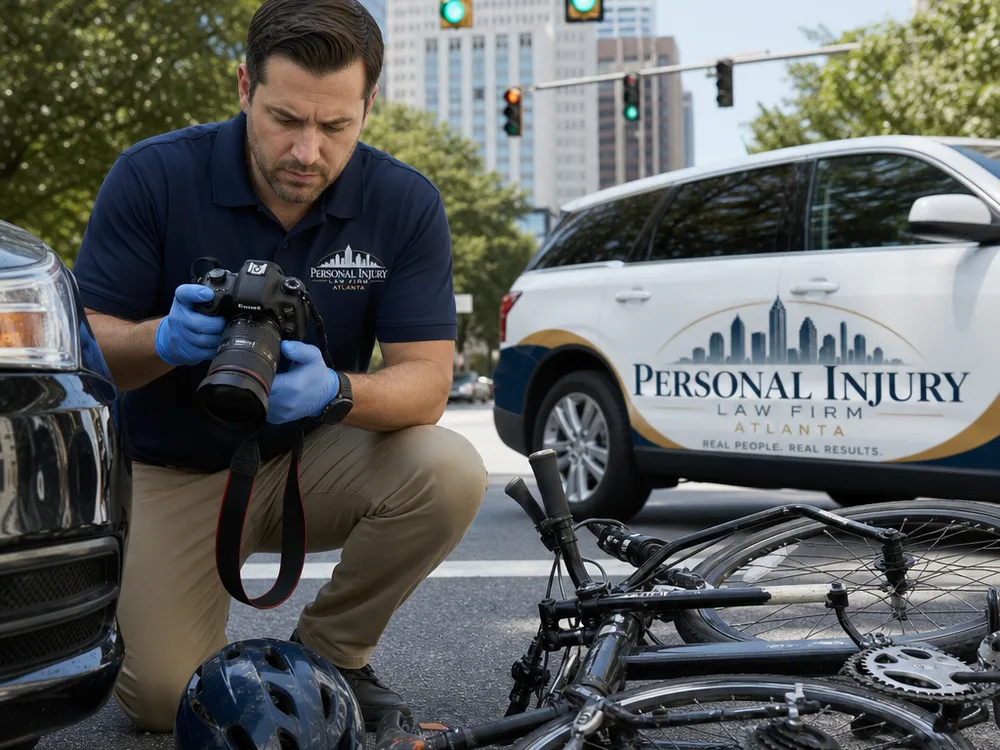
We identify camera sources, request preservation when appropriate, and gather photos, scene measurements, and witness contact details before they disappear.
We connect the injury story to the crash facts: impact points, speed, roadway conditions, and how the rider went down. This matters for concussions, fractures, and soft-tissue injuries.
Georgia uses modified comparative negligence. If the insurer tries to place blame on the cyclist, we address the specific allegation with evidence rather than arguments.
We look beyond the driver's basic policy when facts support it, including employer coverage for work driving or additional policies that may apply.
A strong demand ties liability to damages with records, billing, wage proof, and a precise explanation of future care concerns when supported by medical providers.
Every case is different, but a bike crash claim typically includes a mix of economic and non-economic damages. The value depends on injury severity, treatment course, time out of work, and how clearly fault can be proven.
Common damages in bicycle injury cases include:
If the crash involved a fatality, the legal framework changes and family members may have separate rights and deadlines. If that is part of what you are facing, it is important to ask specifically about wrongful death options during your intake.
A bicycle accident lawyer Atlanta riders hire should also talk to you about the practical timeline. Many claims cannot be valued accurately until treatment stabilizes. Settling too early can leave you responsible for later care that was predictable but undocumented at the time of settlement.
We learn how the crash happened, what treatment you have had, and what communication you have already received from insurers. If evidence may be lost, we prioritize preservation and rapid collection.
We request the crash report, identify witnesses, gather photos and video, and confirm the correct insurance policies. If rideshare, delivery, or work driving is involved, we verify the coverage layer that applies.
We track medical records and billing, document wage loss, and organize the file so the injury story is supported by consistent, dated records.
We present a demand package that explains liability and damages clearly. We respond to comparative fault arguments with specific evidence and push back on low valuation tactics.
If the insurer will not offer a fair outcome, we discuss filing suit in the appropriate Georgia court and moving through discovery, motions, and potential mediation toward resolution.
If you were injured on a bike in Atlanta, the most helpful next step is a focused review of the crash facts, your current treatment, and what evidence can still be collected.
Get a Free Case Review“After my crash, the insurance adjuster kept pushing for a quick statement and a fast settlement. Once I had legal help, the communication got organized, my medical records were pulled correctly, and the claim finally reflected how long it took me to get back to work.”
“They explained what mattered in a bike case: the intersection details, the video sources, and why waiting until my treatment plan was clear protected me from settling too early.”
As soon as you are safe and have started medical care, because key evidence like surveillance video and witness availability can disappear quickly. An early review also helps you avoid missteps with recorded statements and incomplete medical documentation that insurers often use to discount claims.
Georgia follows modified comparative negligence, so fault allocation matters to both eligibility and case value. The right response is evidence-driven: scene photos, video, impact points, timing of signals, and witness statements can rebut claims that the cyclist “came out of nowhere” or was riding unpredictably.
No, you can start the legal process without the report in hand, but the report often provides a baseline narrative, involved parties, and witness leads. We can request and review it while also collecting independent evidence so the claim does not rely solely on an officer's summary.
Concussions and other head injuries, fractures such as collarbone, wrist, and rib injuries, road rash with infection risk, and soft-tissue injuries are common. They often require follow-up care beyond the first ER visit. A claim is stronger when the treatment timeline and symptoms are consistently documented across providers.
The applicable insurance can depend on whether the driver was logged into an app, actively on a trip, or driving for an employer at the time. We investigate status and coverage early because it can change which policies apply and how the claim should be presented.
In many injury cases, Georgia's statute of limitations is two years from the date of injury under O.C.G.A. § 9-3-33. There can be exceptions and special notice rules in some situations, so it is worth getting a case-specific timeline review rather than assuming you have time.
Often the first offer comes before the full medical picture is clear, which can leave you underpaid for ongoing care and time off work. A fair evaluation usually requires medical records, billing, wage documentation, and a liability presentation that addresses any comparative fault arguments.
Share what happened, where it occurred, and what treatment you have had so far. We will outline the next steps for evidence, insurance communication, and pursuing compensation through a Georgia injury claim.