Lock down time-sensitive evidence
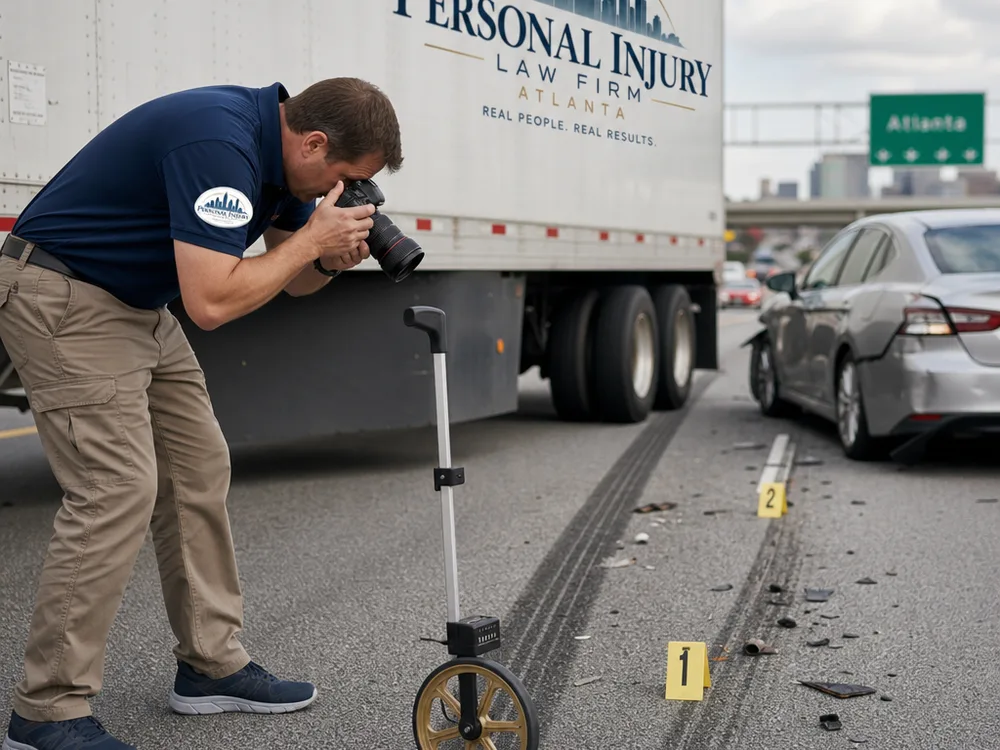
We send preservation notices and move quickly to secure logbooks, electronic data, inspection and maintenance files, and any available camera footage before it is overwritten or lost.
After a serious truck wreck, the insurance side moves fast. Get a legal team that preserves evidence early, builds a clear damages story, and negotiates from strength.

If you are searching for a truck accident attorney Atlanta families can rely on, you are probably dealing with more than vehicle damage. Truck cases often involve catastrophic injuries, multiple defendants, and corporate insurers that start working the file immediately.
A tractor-trailer wreck can pull in the truck driver, the motor carrier, the trailer owner, a shipper or broker, maintenance contractors, and manufacturers if a part failed. Each party may have its own insurance policy, adjuster, and defense lawyer. The evidence is also different: driver logs, dispatch communications, inspection records, onboard data, drug and alcohol testing, and load documents can matter as much as the police report.
Personal Injury Law Firm Atlanta handles truck wreck claims in Atlanta with a focus on early investigation and claim structure. The goal is straightforward: identify every responsible party, prove liability with hard evidence, and document the full cost of the injuries so negotiations and litigation start on solid ground.
If you are also comparing broader injury representation, our team works across serious injury matters through a personal injury law firm in Atlanta.
We send preservation notices and move quickly to secure logbooks, electronic data, inspection and maintenance files, and any available camera footage before it is overwritten or lost.
A truck case can involve layers of ownership and contracting. We map the relationships and coverage so the claim is not limited to one policy when others apply.
We collect medical records, imaging, treatment plans, work records, and future-care opinions to document both current losses and long-term impact.
We take over adjuster contact so you are not pressured into recorded statements or quick settlement offers before the full injury picture is clear.
Strong claims are built to stand up in court. That posture often improves settlement leverage and keeps the timeline under control.
In Atlanta, heavy commercial traffic means truck collisions often occur on major corridors like I-75, I-85, I-20, and the I-285 Perimeter, as well as freight routes leading to industrial areas. Where the crash happened affects the evidence you need and the agencies involved.
For example, an interstate crash can involve multiple responding units and rapid scene clearance, which makes early witness and camera outreach important. A wreck near Downtown or Midtown may have additional third-party video sources such as nearby businesses, rideshare dash cams, or parking facilities. Collisions near the airport area and connecting routes can involve high traffic volume and complex merging patterns that require careful reconstruction.
As a truck accident attorney in Atlanta, our job is to connect the scene facts to the legal theory of fault. That can include distracted or impaired driving, speeding, following too closely, unsafe lane changes, hours-of-service violations, negligent hiring or supervision, poor maintenance, overloaded cargo, or improper securement.
If your injuries make travel difficult, ask about remote intake and document collection so the case can move forward without adding strain.
We gather the basics of the crash, injuries, providers, and insurance contacts, then outline what documents to save and what communications to avoid.
We request reports, locate witnesses, seek video sources, and send preservation demands for carrier records and electronic data that can clarify speed, braking, and duty status.
We track treatment, obtain records and bills, and document work impact. When appropriate, we develop future-care and impairment support so the demand reflects long-term needs.
Once liability and damages are well supported, we present a structured demand. We negotiate with the insurer group while keeping the case ready for litigation if talks stall.
If a fair result is not offered, we file and pursue discovery, depositions, expert work, and motions, with settlement opportunities continuing throughout the case.
Every case depends on the injuries and the available coverage, but a well-built truck case usually evaluates both economic and non-economic damages.
Economic damages often include medical bills, rehabilitation, prescriptions, mileage for treatment, lost wages, and reduced earning capacity when you cannot return to the same work. Non-economic damages can include pain, limitations, scarring, and the day-to-day losses that do not come with a receipt but are real and documentable.
Wrongful death cases can involve different categories of recovery and different decision-makers, so the strategy and the documentation change. If you are handling a loss, the priority is to protect the claim early while keeping the family's burden manageable.
Be cautious with early settlement discussions. Truck insurers may offer quick money before the full diagnosis is known or before future procedures are recommended. Once you sign a release, you generally cannot go back for more even if complications appear.
If a commercial truck was involved, the best time to protect evidence is now. Share what happened, and we will explain the strongest path forward based on the facts and your medical situation.
Call for a Free QuoteAs soon as you are safe and medically stable, because key trucking evidence can be time-sensitive. Items like driver logs, dispatch messages, onboard data, and third-party video may be overwritten or harder to obtain as days pass, so early preservation and requests often make a difference in proving fault.
They usually involve more defendants, more insurance layers, and more technical evidence. A tractor-trailer claim may include the driver and the motor carrier, plus maintenance contractors, the trailer owner, and cargo-related parties, and each can dispute responsibility unless the case is built with records, expert analysis, and clear causation.
Possibly, and the outcome often turns on objective evidence rather than statements at the scene. We look for crash reconstruction factors, vehicle damage patterns, roadway conditions, witness accounts, and any electronic data that shows speed, braking, and following distance to assess whether the truck driver had time and space to respond safely.
It is usually safer to avoid a recorded statement until you have legal guidance, because questions may be designed to lock you into wording that shifts blame or minimizes injuries. Your lawyer can handle insurer communications and provide necessary information without risking misinterpretation.
Simple cases may resolve in months, while serious injury truck cases often take longer because treatment needs time to stabilize and liability disputes can require litigation. A clear timeline depends on your medical course, the number of involved insurers, and whether the case needs formal discovery to obtain carrier records.
Get follow-up medical care, keep every discharge paper and bill, and write down what you remember while it is fresh. Also save photos, vehicle damage images, and any messages from insurers, and avoid posting about the crash or your injuries on social media because those posts can be taken out of context.
Yes, when the facts support it, the claim can go beyond driving error. Carrier responsibility may involve negligent hiring or supervision, failure to inspect or maintain brakes and tires, or allowing unsafe scheduling that encourages hours-of-service violations, and those theories are proven with the company's own records and testimony.
Tell us what happened and what care you have received so far. We will outline next steps, the evidence to preserve, and how an Atlanta truck wreck lawyer builds the claim against drivers, carriers, and insurers.